


Photos: Tom McNally. Words: David Felton.
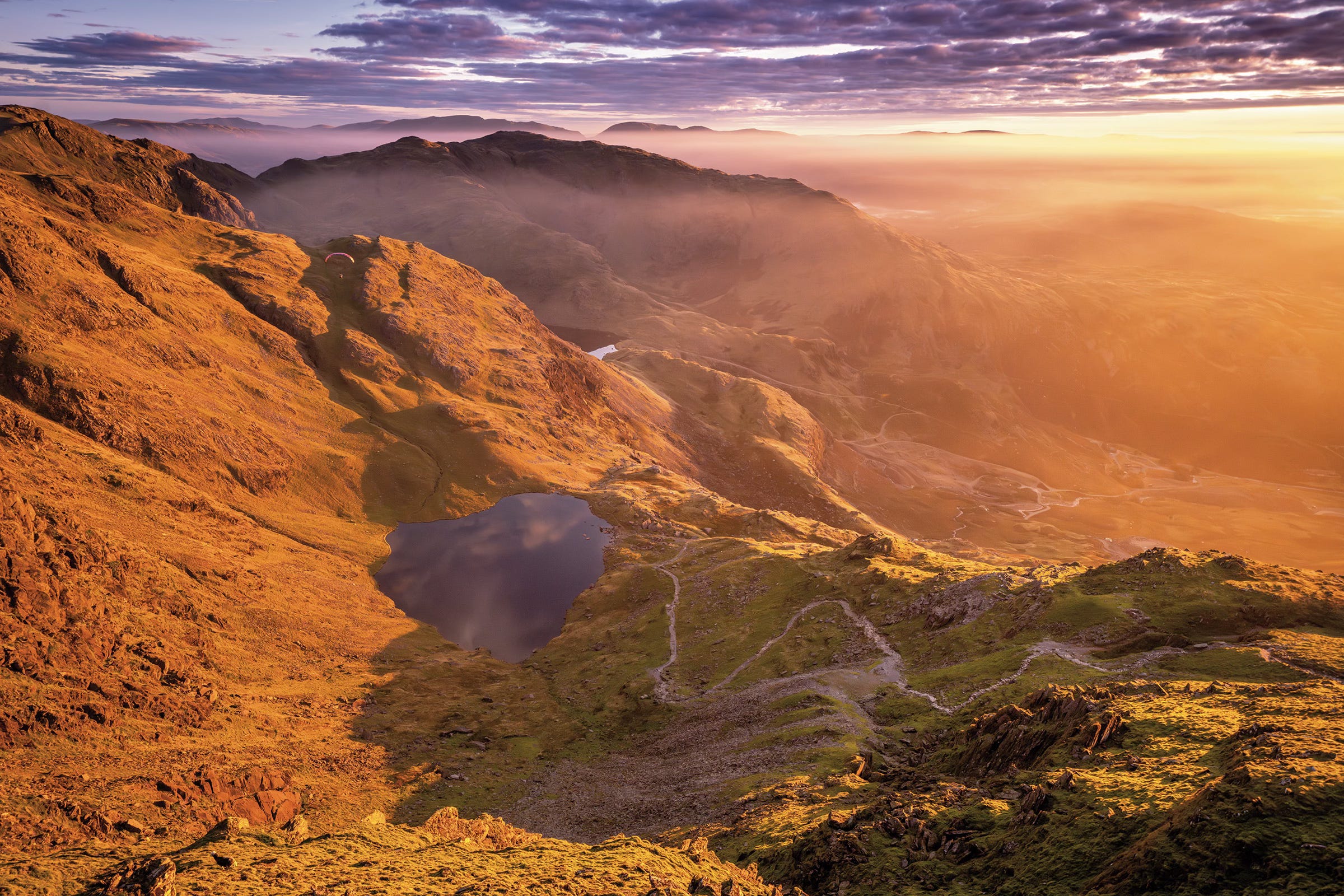
No mountain better showcases the Lake District’s neglected industrial history than Coniston Old Man, the fell with a hole in its heart. For four centuries the county top of old Lancashire was worked for slate and copper – the latter in such quantities that its eastern valley is named after the mineral. While this sprawling southern height – with fine outlooks over the estuaries of the Kent, Leven and Duddon – may feature in few fell-baggers’ Lakeland top trumps (or TUMPs1), for a dedicated band of adventurers, the Old Man is a site of pilgrimage. These are the Cumbrian mine explorers, whose natural habitat is not the airy heights or the raven-haunted crags, but a subterranean labyrinth of rock cathedrals, echoing shafts, mineral waterfalls and mist-filled voids, where abandoned picks and carts, ladders and tobacco pipes evoke the labouring ghosts of a lost age.
Into the deep
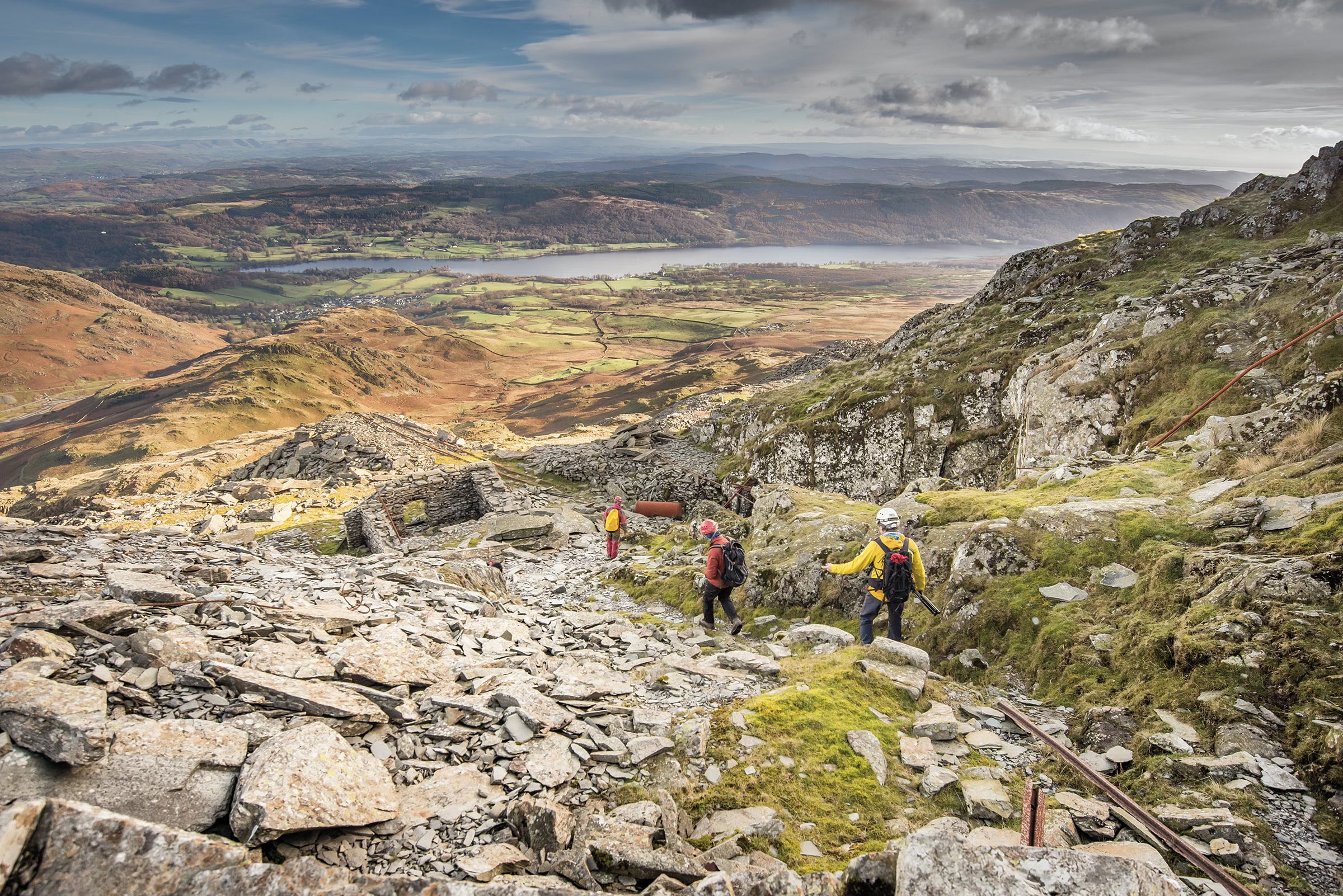
One of those who has gone down the underground rabbit hole is Mark Hatton, Ambleside-based mine historian and a trustee at the Cumbria Amenity Trust Mining History Society (CATMHS). “For 50 of my 60 years I was ignorant of mining history in the Lake District,” says Mark. “All of our family holidays as children were spent in the Lakes. Walking the fells was what we did, and it’s what I continued to do as an adult. I walked over spoil heaps and past adit entrances, but I didn’t see any of that lost history – it was hiding in plain sight. Then one windy weekend, I was looking for climbing opportunities in Borrowdale. The usual crags were out of bounds, and one of the guys in our group said: ‘There’s a mine here you can visit.’ We spent a day exploring the wad mines above Seathwaite, and it changed my life – it exposed me to the mining heritage of the Lake District, which is rich and varied, and goes back centuries. Since then I’ve spent 15 years revisiting the fells I thought I knew, discovering new things in familiar places.
“And boy, did I find a bounty of new things – a mining history which has left so much behind. You realise that before the Lake District became the tourist honeypot of ‘Wordsworthshire’, it was an industrial landscape where men, women and children tried to eke out a living in the most savage of environments.”
Arrival of the Germans
The industrial history of Coniston stretches back at least 1,075 years, with remains of the oldest Cumbrian bloomery found on the west shore of Coniston Water (then Thurston Water) dated to around AD950. The wealth of Coniston, though, was not iron but copper – found in a complex of veins worked to a depth of 1,500 feet that extends west to Prison Band and east to Hole Rake.
It is impossible to know when copper was first discovered or worked in the valley (it is a perennial mine archaeologist’s challenge – because more recent workings tend to expand upon, and destroy, older ones), though the ore would originally have been discovered by prospectors walking up stream beds, seeking overground mineral outcrops exposed by fluvial erosion. A waterfall in neighbouring Greenburn, for example, still has copper visible in the rock alongside it, with a mine level directly below.
“The birth of copper mining in Coniston is traceable to the 1590s,” says Mark. “From then, it was worked in phases punctuated by periods of dormancy. The first major period of expansion was at the end of the 16th century, when miners from Keswick moved south from the near-exhausted Newlands mines.”
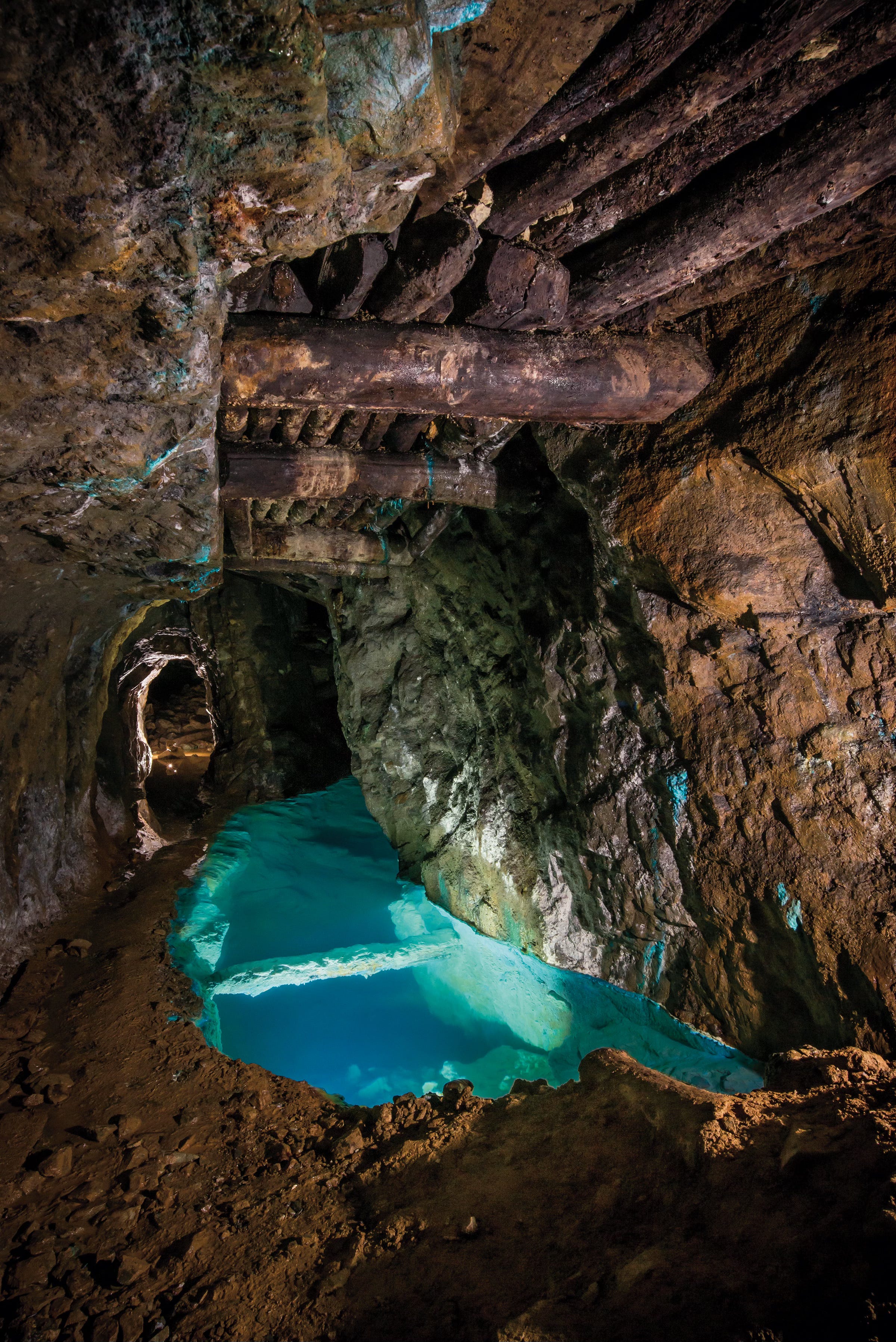
These were second-generation Germans employed by the Company of Mines Royal, originally invited to England from Augsburg by Queen Elizabeth I. With Spanish invasion a looming threat, the monarch countered the nation’s dependency on imported metals by introducing German engineering and extraction expertise to a country still languishing in the industrial dark ages. By the 1590s, the Newlands copper veins were too deep and distant to profitably mine. So the Germans looked south to Coniston, where they discovered (or re-discovered) a bounty of mineral riches.
“The Elizabethan miners, who worked the rock using picks and hammers,” explains Mark, “adopted a lot of the existing infrastructure, and the key infrastructure here is a water management system. The Coniston area is not blessed with coal, so the power the Victorians used was water.” The valley’s remarkable water system – still visible in Coppermines today – comprises a series of stone-channelled canals, or leats, that criss-cross the hillsides below Levers Water, the main headstock. Originally a corrie tarn, Levers Water was dammed and its level raised in 1717, outflow used to power whale blubber-lubricated waterwheels – up to 50 feet in diameter – that did everything from winding winches and pumping water to crushing stone.
Down ‘cobblers hole’
Coppermines reached its industrial zenith from the late 1820s, when John Taylor, one of the industrial titans of his age, took the mine’s lease, transforming it into the most profitable operation of its kind in the north of England. Historians can paint a vivid picture of the valley at this time due to a contemporaneous account in The Old Man; Or, Ravings and Ramblings Round Conistone written by Alexander Craig Gibson (1813–1874), a surgeon employed at the mine in the 1840s. “The miners were, counter-intuitively perhaps, a relatively healthy bunch,” notes Mark; “as a consequence, Gibson had time on his hands to write a guidebook.”
The surgeon sets the scene for his guided ‘rambling’ into Coppermines Valley by describing: “amongst the hills... ‘a little town’ of sheds, offices, workshops, and waterwheels, which, with the constant clatter of the machinery issuing therefrom, presents a most extraordinary contrast to the silence and solitude of the surrounding wilderness”. Mark augments the picture: “We’d be surrounded by noise and movement, with water-wheels driving winches and huge iron-shod stamping machines used to crush the rock. Men, women and children would be pushing metal-wheeled barrows around and hitting rock with sledgehammers. By the 18th century, gunpowder had replaced picks, chisels and hammers, so every few hours you’d hear a blast below ground as new ore was exposed.”
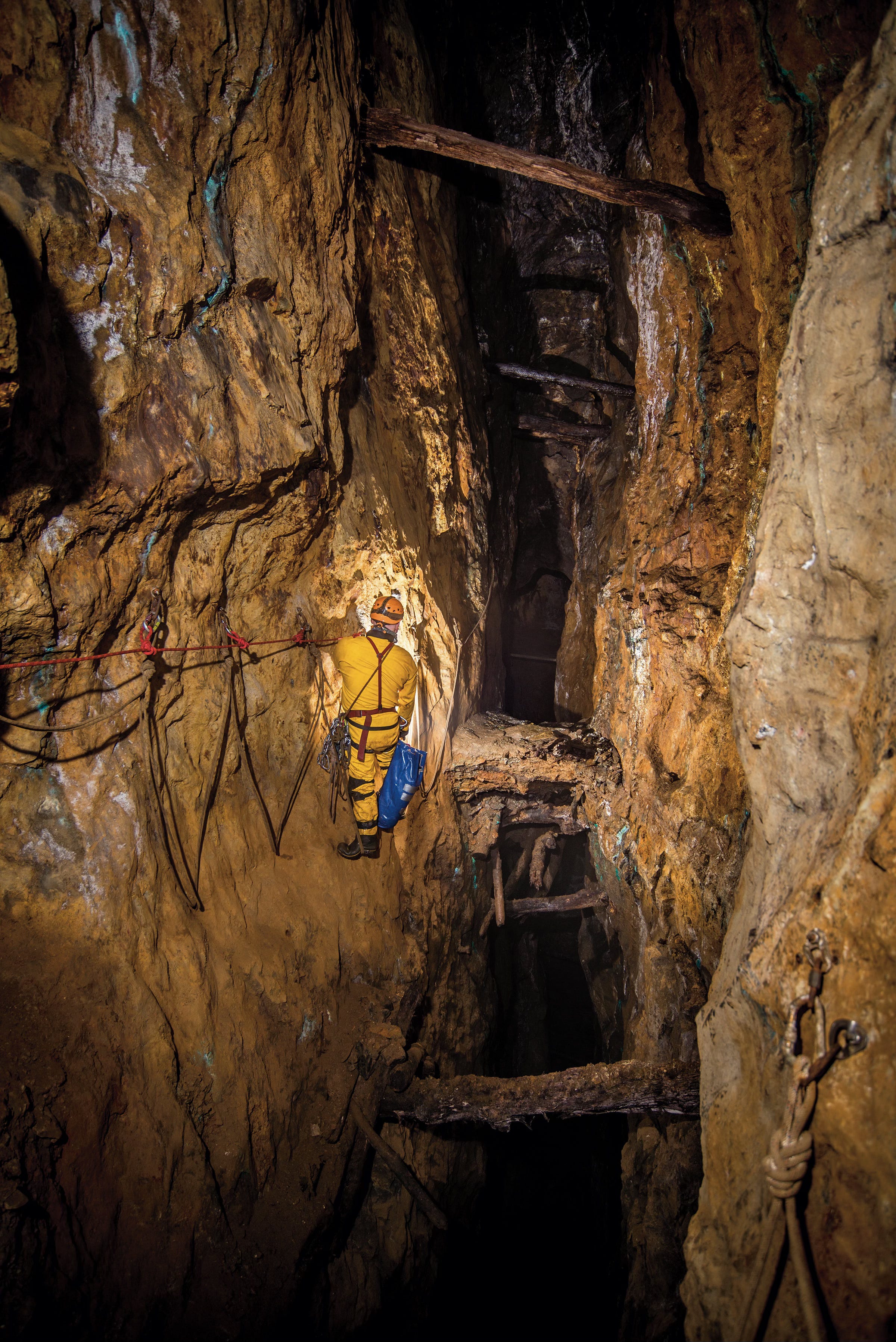
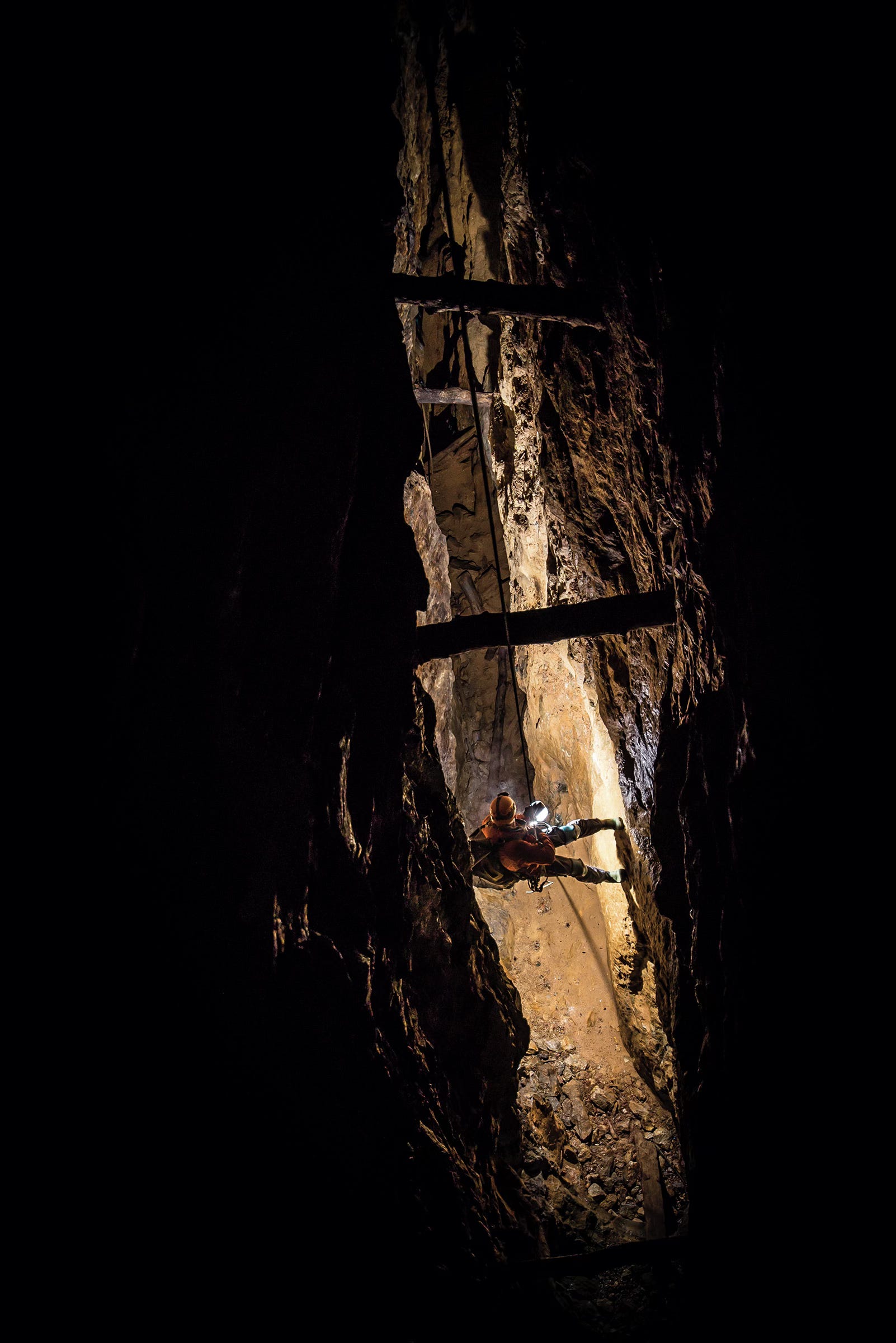
Gibson walks the curious explorer steadily upstream to Horse Level, which drives into the mountain for one and a half miles and was used both to drain the mine and as a tramway for horse-drawn wagons transporting ore to the processing floor. Here he suggests that the visitor procures “candles and a guide” before arriving at ‘Cobblers’ Hole’, “a tremendous chasm” that extends upwards “a few fathoms”, and down many more. ‘Kibbles’ (baskets) containing ore are here seen being winched up the void by a waterwheel on the southern flank of Wetherlam. Gibson proceeds to take the reader ever deeper into the hole – down “a series of ladders, with wooden sides and iron steps”.
“As you proceed on your perilous journey, you must not allow the thunderous echoes of the distant blasts or the astounding rattle of the rapidly descending kibble and its chain,” warns Gibson, “to deprive you of your presence of mind, else you are ‘but a dead’ tourist.” The surgeon drops 70 fathoms down Cobblers’ Hole – around 420 feet – where he finds miners perched on ‘bunnins’ (wooden platforms) chipping at the rock face “like inhabitants of a still lower region”.
In a book of eye-opening curiosities, perhaps the strangest is Gibson’s revelation that any passing tourist might ask for a mine tour – “such leave has never been refused during the reign of the present liberal and enlightened manager”. Concerns of the Health and Safety Executive lay many decades in the future.
Laughter in the dark
The working population of Coppermines – as many as 500 people in its John Taylor heyday, some as young as six years old – was diverse and transient. “Coniston was, at that time, a mining village, its agricultural population in the low dozens,” explains Mark, “and it was a village of immigrants. One of the main mining areas in the valley is Paddy End, named because Irish labour was a key manpower resource.” Indeed the row of former miners’ cottages in the valley – now holiday lets – was known as Irish Row, referring to the period of migration that followed the Potato Famine.
Incomers were not always welcome, with arm’s-length relations between the Irishmen (who tended to live in bothies on the hill) and English labourers – the Yorkshiremen, Cornishmen and native Cumbrians – who lodged in, and swiftly expanded, Coniston.
Work was tough, and accidents not uncommon. Gibson writes about a young Irishman, surname Redmond, winched up a mineshaft latched to a kibble. His father – working the same vein – looked on as, moments later, his son’s body “tumbled down the shaft” to his death. Above ground, meanwhile, waterwheel operator Thomas Millican’s body was torn to shreds in a tragic accident that saw him dragged into his wheel pit.
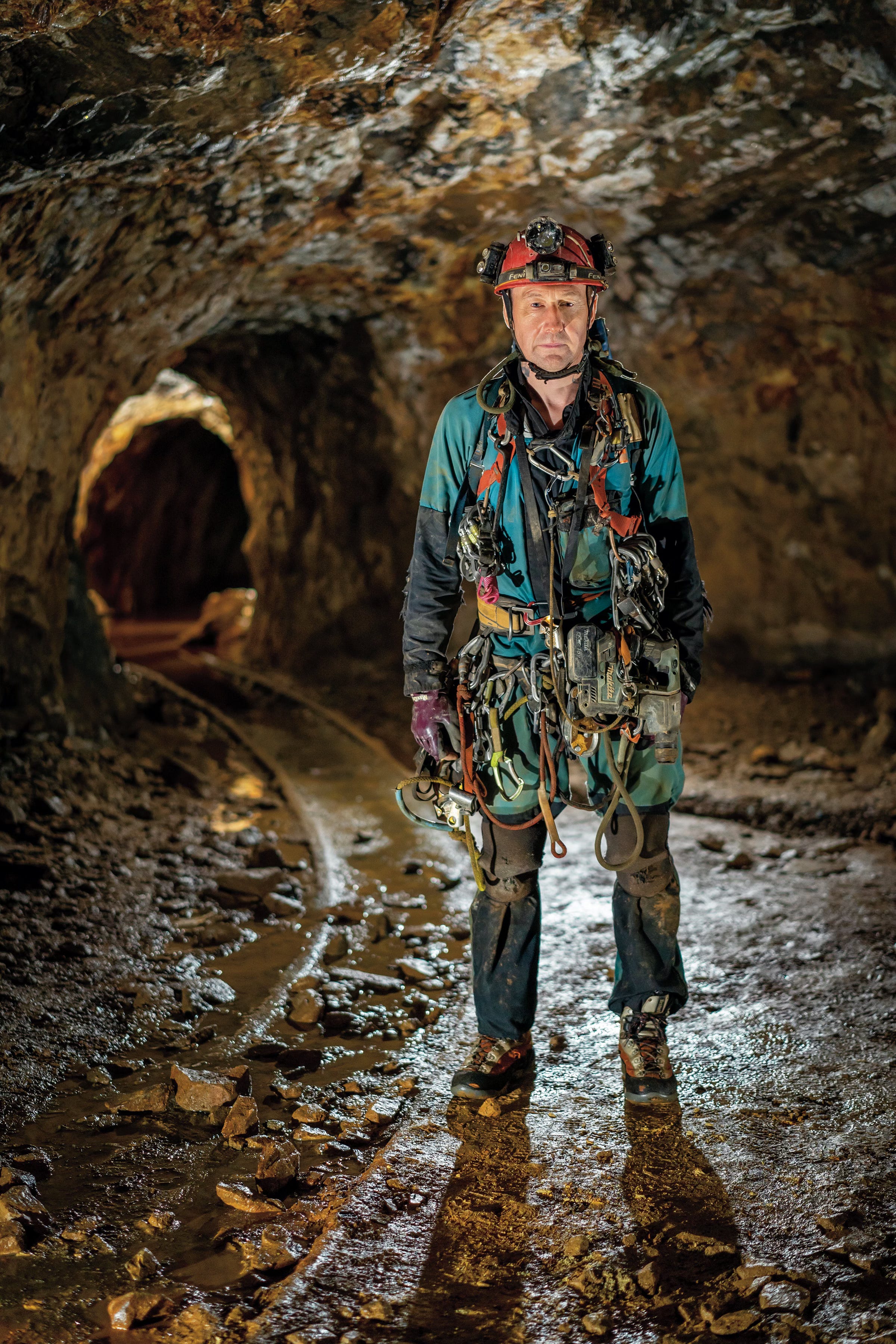
But it was gunpowder – used to loosen rock from the working face – that caused most injuries. “Once you’ve set a charge and lit the fuse,” notes Mark, “you should never go back to it if the gunpowder fails to blast. But miners ignored rules like that. If it didn’t fire, they might wait a couple of minutes, then return to see what was going on – only for the charge to ignite. The blast was often sufficient to kill a man outright. If it didn’t kill him, it would take a hand off or eye out. You find plenty of records of miners who were permanently disabled by losing a hand or an eye. Typically they’d have to find another job, so the Coniston postman had a hook for a hand and one eye, and many disabled miners ended up begging on the streets of Kendal – the nearest industrial town where people had sufficient cash to spare a few pennies.”
Perhaps because of the graft involved, there was dark humour aplenty below ground. Gibson describes meeting an older worker who was warned by a visiting agent about rubble falling down a shaft: “Take care – or you’ll have your brains knocked out!” “He continued his work,” recounts Gibson, “replying coolly, ‘If I’d ever had any brains, Captain, I shouldn’t have been here.”
A whimper, not a bang
In its 300-year lifespan an estimated 100,000 tons of refined copper ore came out of Coniston. That copper was mixed with tin (90 per cent copper, 10 per cent tin) to make bronze, and with zinc (80 per cent copper, 20 per cent zinc) in the production of brass. The ore was initially transported to the great smelter of its age at Brigham in Keswick, packhorse trains hauling panniers of ore over Red Bank then Dunmail Raise to Keswick (in the spring of 1602, 500 locals were employed in transportation). Two centuries later, mine income was enough to justify the construction of a new Furness Railway spur between Broughton-in-Furness and Coniston, negating the need to ferry ore via Coniston Water and the Ulverston Canal before it was shipped to John Taylor’s smelters in South Wales.
By this time, however, the mine’s days were numbered. “Like virtually all mines,” says Mark, “operations at Coniston ended with a whimper rather than a bang. There was a period of decline from the 1860s, mainly caused by the fact that as surface-level veins were exhausted, miners had to dig deeper and further, driving up the cost of production. Meanwhile, the price of copper was falling. Imports from South America, Scandinavia and Africa flooded the market and undercut the price of domestic production.
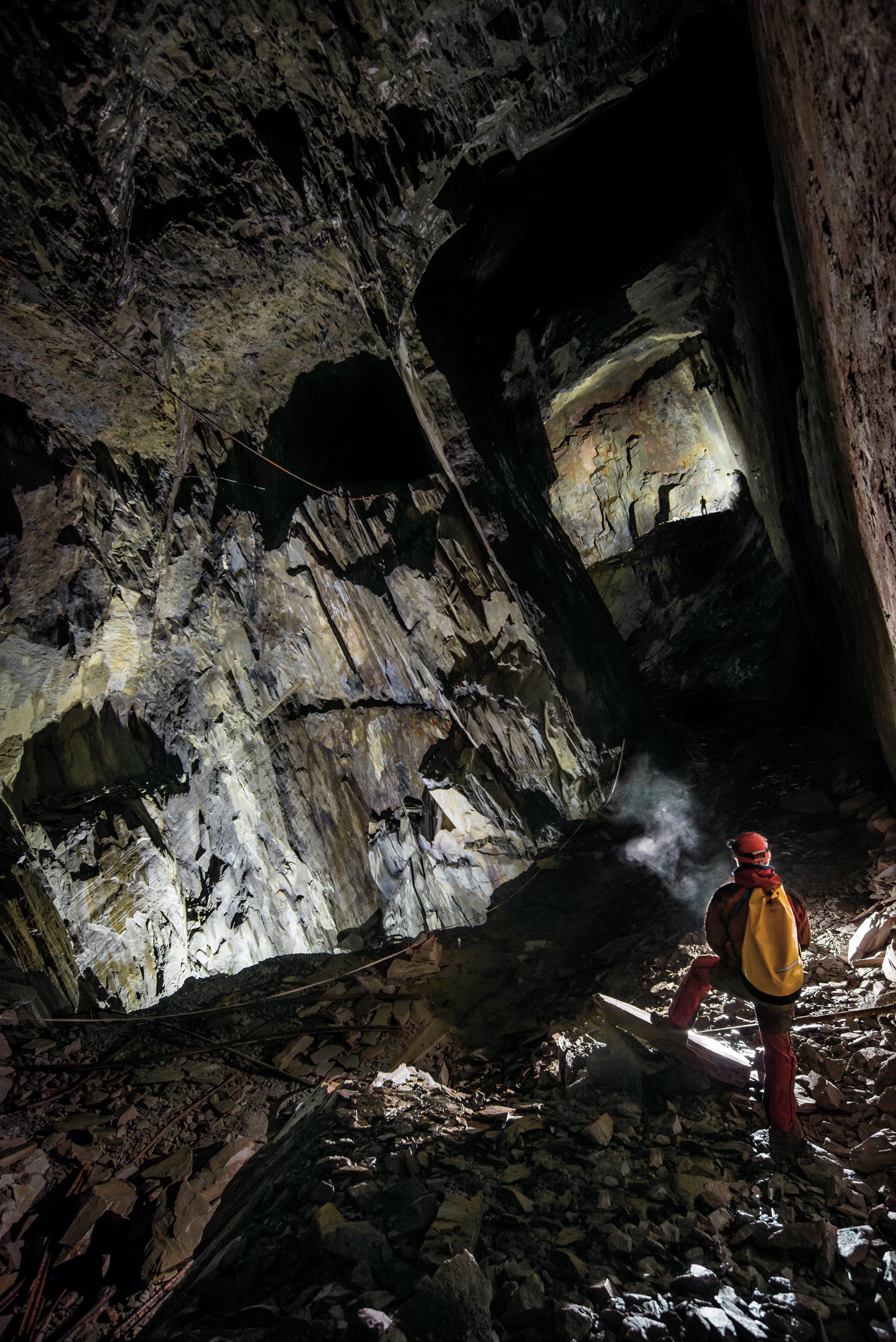
“The Coniston mines were faced with a fatal double-whammy of higher operating costs and lower selling prices. During the 1870s and ’80s, the mine ran out of steam, then money, and by the early years of the 1890s it was all over. The work faces were abandoned, the waterwheels switched off, the pumps stopped working, and over the next five years the lower levels filled with water, leaving a vast waterlogged catacomb that is forever out of bounds. In some of the furthest tunnels, you find old carts and ladders – even clay pipes – left by miners who thought they would return to work on their next shift, but never did.”
This chapter is one of 40 taken from the forthcoming book Forty Fells published by Inspired by Lakeland. You can pre-order a signed copy here.

TUMPs are hills with a drop of at least 30 metres or more on all sides. The acronym stands for ‘Thirty and Upward Metres of Prominence’.
Loved reading this - thankyou
Look forward to reading the forthcoming book. Great chapter.